

Gretna Green
Battery Energy Storage System
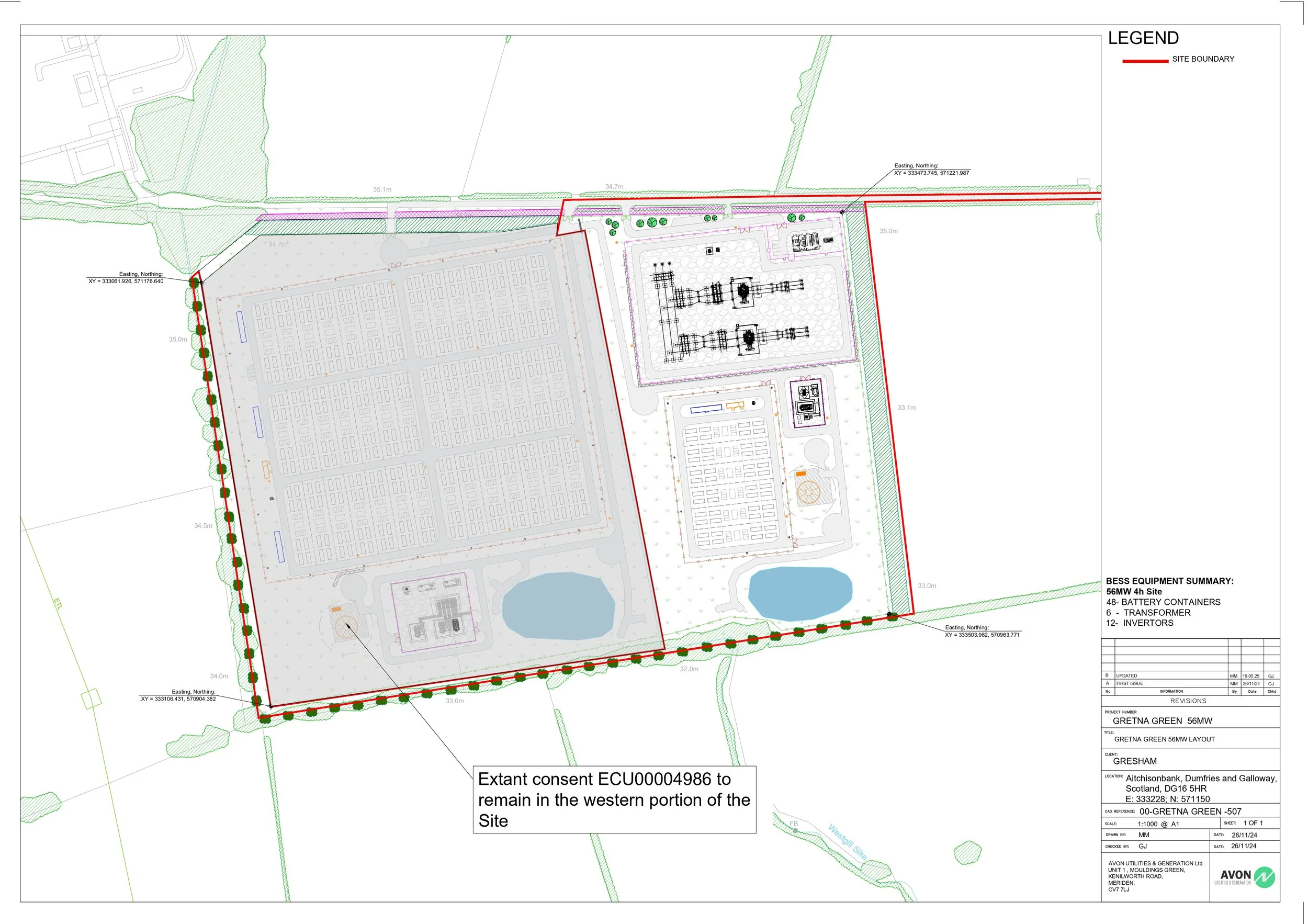
Gretna BESS was granted consent by the Energy Consents Unit in 2025 under reference ECU00004986, authorising a 456MW Battery Energy Storage System on land south of Gretna 400kV substation, Gretna Green, DG16 5HR.
We are consulting on proposed operational arrangements separating the consented scheme into Parcel A (approximately 400MW) and Parcel B (approximately 56MW). Sign up for the webinar below, which will explain how these arrangements relate to the existing consented scheme and provide an opportunity to comment before an application is submitted.
Register for the webinar
Wednesday 4 November 2026 · 6pm–7pm (GMT)
Online via Microsoft Teams
Please sign up via the link below
Have your say
Please send comments to feedback@gretnabess.co.uk by Sunday 8 November 2026.
Comments made to the applicant are part of the pre-application consultation process and are not representations to the Scottish Ministers. If the applicant submits a planning application, there will be an opportunity to make formal representations on the application to the Scottish Ministers.
What are we proposing?
Gresham House Devco Pipeline Ltd are preparing to separate the consented scheme into Parcel A (approximately 400MW) and Parcel B (approximately 56MW). The scheme sits on land south of Gretna 400KV substation, Gretna Green, DG16 5HR.
The BESS infrastructure will connect to the neighbouring substation. The infrastructure will include battery energy storage containers, PCS (inverter-transformer), grid connection infrastructure, access tracks, and safety and security measures, including Security gates and Closed-Circuit Television (CCTV).
Landscaping including generous biodiversity enhancements are proposed to screen the development, and minimise impact on its surroundings.
Why does Scotland need BESS?
Energy storage is a crucial technology that holds particular significance for Scotland. The Scottish Energy and Climate Change Directorate, in its Draft Energy Strategy and Just Transition Plan (January 2023), has emphasised the importance of battery storage for Scotland.
This focus aligns with the broader goals outlined in the “British Energy Security Strategy” published in April 2022, which seeks to transition the UK away from fossil fuels towards clean energy.
Energy storage plays a key role in making renewable energy sources more reliable and efficient, especially as we transition to smaller, intermittent power generations systems.

Energy Security for Dumfries and Galloway
Gretna Green BESS will reinforce Scottish Power infrastructure, by offering backup power and stabilising services and securing energy provision and preventing blackouts.
The split Gretna Green BESS will have a storage capacity of up to 400 and 56 MW of electricity, which helps to maintain grid stability and secure the power supply for thousands of UK family homes while supporting the local transition to Net Zero through low carbon infrastructure.
The Scottish Government has set a target within The Climate Change (Emissions Reduction Targets) (Scotland) Act 2019, to achieve net-zero emissions by 2045. National Grid stated that batteries are required to ensure that energy generated by renewables can be stored when it is not required, and then used when it is, as well as to provide power quality services as traditional generation is phased down. Dumfries and Galloway Council declared a climate emergency in June 2019, stating:
“Gresham House can help to play a part in providing these vital batteries. Gretna Green BESS will assist the Council in reaching its net zero goal of 2025, and leading on the transition to cleaner and greener technologies.”
FAQs
-
Battery energy storage sites typically do not create sounds louder than the natural background noise. A thorough noise evaluation is being completed for this site. To further reduce any potential noise, the project plan will include various noise mitigation measures, including the possibility of acoustic fencing and green borders, such as native tree or hedge planting.
-
The battery enclosures are meticulously designed to ensure safe operation throughout the entire project’s duration. Enhanced safety features, such as ongoing monitoring of individual battery cells, are implemented to quickly address any possible issues and maintain the highest level of safety.
Battery energy storage systems are engineered to meet strict safety guidelines set by international regulatory organisations like the International Electrotechnical Commission (IEC). These comprehensive standards cover all aspects of battery storage systems, including installation, operation, and maintenance, to guarantee full compliance with the most rigorous safety standards.
The battery containers will also be distanced from one another, and remotely monitored to ensure immediate shut down in case of an emergency.
-
The BESS is a temporary development and will not change the land classification. When the BESS has been decommissioned, the consent will require the land to be restored to its previous purpose as agricultural land.
Temporary development consent ensures that the land will not be classed as ‘brownfield’ after decommissioning.
-
We have secured a grid connection agreement with Scottish Power Transmissions to connect to the adjacent substation and the timing will be subject to securing planning permission and our confirmation of the construction programme.
-
The Lithium-Ion batteries that will be used in the project are not reliant on scarce raw materials. There are established recycling processes for recovering the most common elements used in battery construction - cobalt, nickel, lithium and manganese - for re-use.
-
Once the BESS facility is operational, it will maintain a minimal presence, primarily necessitating occasional visits for operations and maintenance. The only period that might potentially affect traffic is during the temporary construction phase.
During the construction of the BESS facility, traffic will be effectively managed through a Construction Traffic Management Plan (CTMP). This plan will incorporate measures such as an HGV booking system and time- based restrictions for traffic arrivals on-site, with the aim of preventing local network disruptions during peak times, like rush hours and school drop-off or pickup times. In preparation for the planning submission, local input on additional measures to minimise impact is highly encouraged.
-
We have prepared a board on the swept path of the construction route, which indicates the possibility for a 16.5, long HGV to get over the narrow Sark Bridge. The possibility of creating passing places along this road are also being explored.
Further, we will ensure that HGVs are not using the roads around the site at peak usage times, such as during rush hour or the school run, to ensure safety for local residents.
-
Once the proposal receives consent, the project team will engage with Transport Scotland regarding the proposed access route. Construction Traffic Management Plan (CTMP) will be put in place which will detail further the usage terms of any access roads.
About Us
Gresham House is a specialist alternative asset management group with a strong sustainability focus in battery energy storage, renewable energy, sustainable infrastructure, and forestry. With origins dating back to 1857, we are committed to long-term investments in a greener future.
Gresham House New Energy, our clean energy division, oversees the development of battery energy storage facilities. Our strategy supports the transition from finite resources to renewable energy. With a proven track record, our team manages over 2,500MW in renewable energy and battery storage assets, including the UK's largest battery energy storage fund, GRID, operating 600MW across 21 sites.
For more information visit: www.greshamhouse.com
We value your input and feedback in shaping this project proposal. Thank you.


Contact
This website forms part of our pre-planning application process.
We would be grateful if you could fill out the feedback form below and let us have your contact details for the purpose of informing the project design and our planning application.
For further information, please do not hesitate to email feedback@gretnabess.co.uk
Please view Alpaca Communications’ privacy policy here.